

The European Green Deal sets a bold course for a climate-neutral Europe by 2050. To achieve this, the EU aims to cut greenhouse gas emissions by at least 55% by 2030 (compared to 1990 levels) and accelerate the shift toward a circular economy that drastically reduces waste and resource consumption. The construction sector stands at the heart of this transformation challenge:
- It accounts for 50% of all raw materials extracted in the EU
- And generates 35% of the Union’s total waste
These figures highlight the urgent need to rethink how we build, demolish, and reuse materials across the value chain.
CEMLOOP XL: an industrial solution for a circular, low-carbon future
CEMLOOP XL directly addresses this challenge by introducing an innovative industrial process that combines:
- Circular recycling of fibre cement waste from construction and demolition
- With a cutting-edge carbon capture and utilisation (CCU) technology that restores the material’s cementitious properties using flue gases from cement kilns
This closed-loop approach enables the production of low-carbon cement from waste, while significantly reducing CO₂ emissions and the need for natural raw materials. This way, CEMLOOP XL proves that industrial performance, circularity, and climate ambition can go hand in hand.
- Innovative technology
Two processes, one goal
CEMLOOP XL comprises two processes operating in Belgium:

RFCP production
Etex, in collaboration with a recycling company, is implementing a new process that transforms fibre cement waste from its own production lines and the broader construction sector into a fine powder called Recycled Fibre Cement Paste (RFCP). By reintegrating this material into the construction value chain, the process avoids landfilling and prevents its downcycling into low-value applications. A new recycling facility in Hemiksem is currently under construction, with completion expected by mid-2026.

CCLIX
At its Lixhe cement plant, Heidelberg Materials upgrades the RFCP. Through a process known as enforced carbonation, a technology developed by the company, carbon dioxide from the kiln’s exhaust gases is put in contact with the RFCP and will react to produce carbonated RFCP (cRFCP). This material regains cementitious properties and becomes a high-quality secondary raw material that can partially substitute for clinker in the production of low-carbon cement. A dedicated carbonation reactor will be built at the Lixhe site, with commissioning expected in late 2028.
- Environmental advantages
Through closing the loop for fibre cement production, the CEMLOOP XL project leads to the following key environmental benefits:
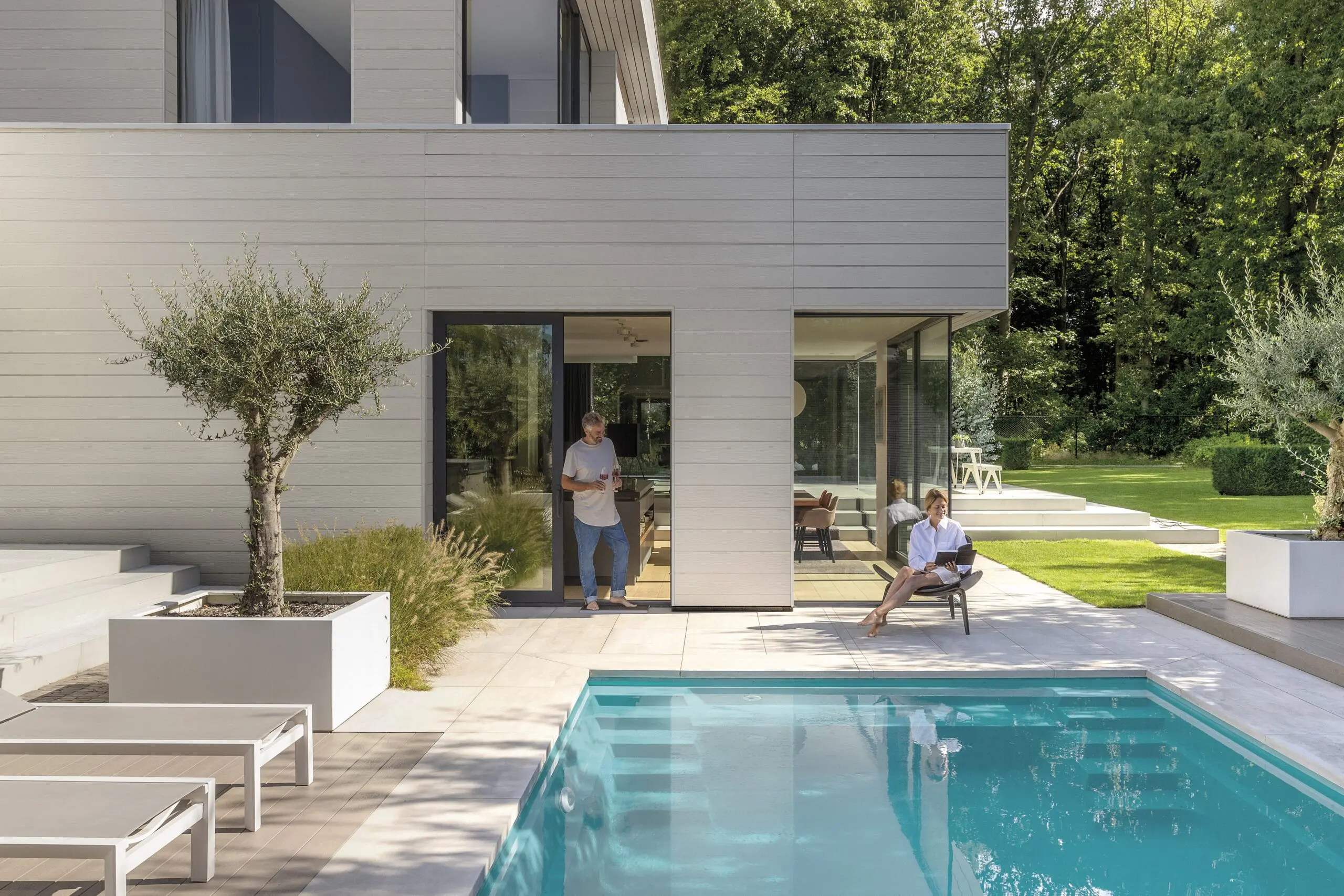
Circular model
Establishing a truly circular model for fibre cement production, allowing Etex to provide the market with truly circular construction products, with a recycled content exceeding 20% and an average reduced CO₂ footprint of 15% of this new fibre cement material.
Diverting from landfill
Diverting fibre cement from landfill or low-quality downcycling; CEMLOOP XL will allow to the elimination of any landfilling or downcycling of fibre cement waste (60,000 t per year) and avoid sending inert fibre cement construction and demolition waste to hazardous landfill.
Saving of the raw materials
Saving of the raw materials used in cement production (primarily limestone) of at least 25% as clinker will be replaced by the carbonated RFCP in the final cement. Due to recycling, around 100,000 tonnes less limestone will have to be extracted each year.
Reduction of CO₂ emissions
Reduction of CO₂ emissions generated by the cement production of at least 20% via capturing and storing a part of the CO₂ emissions from clinker production and further CO₂ avoidance by clinker substitution with carbonated RFCP in the final cement.
Reduction of embodied (grey) energy
Reduction of embodied (grey) energy, i.e. the total energy needed to produce a product, of the final cement of at least 15% also accounting for the CCU process.
- Locations
Two different
locations
in Belgium

Hemiksem
The new fibre cement recycling plant will be built in Hemiksem (Antwerp), on a former concrete and sludge recycling site, an ideal location due to its central position near major Etex plants and its direct access to water transport, enabling efficient shipment of recycled fibre cement paste (RFCP) by boat.

Lixhe
The enforced carbonation unit will be installed at the Heidelberg Materials cement plant in Lixhe, where the production of circular, low-carbon cement from recycled carbonated fibre cement paste (cRFCP) will also take place. Located in Eastern Belgium, in the province of Liège, the Lixhe site benefits from direct access to major rail and motorway networks, as well as the Albert Canal, enabling efficient cement transport by ship. Since 1950, the site has combined two quarries (Loën and Romont), a clinker production unit, and a grinding centre. It also houses advanced laboratories that monitor raw materials, fuels, substitutes, and every stage of the production process. With an annual capacity of 1.4 million tons of clinker and 1.5 million tons of cement, Lixhe is a key player in the region. Around 80% of its cement is delivered in bulk, with 30% transported via waterways. Lixhe is also a leader in sustainability: it is the first cement plant in the Benelux to receive CSC Platinum certification, the highest recognition for responsible and sustainable cement production.

- the life programme
Powered by the LIFE Programme
The LIFE programme is the European Union’s main funding instrument for supporting innovative projects that advance environmental protection, climate action, and the transition to a sustainable economy. It aligns closely with the goals of the European Green Deal, helping public and private actors implement concrete solutions to reduce greenhouse gas emissions, preserve biodiversity, improve resource management, and accelerate the shift toward circular models. It finances pilot initiatives, large-scale industrial demonstrators, and high-impact, replicable solutions, with EU co-funding reaching up to 60% of eligible costs.
- Timeline
From pilot to industry
May 2025 – Project launch
- The CEMLOOP XL project begins, running for 54 months until October 2029.
Mid-2025 – Etex and Heidelberg Materials kickoff
- Etex starts designing a fibre-cement recycling pilot.
- Heidelberg Materials begins preparatory studies for the CCLIX carbonation pilot.
Mid-2026 – Recycling facility commissioning
- The new recycling facility in Hemiksem is expected to be commissioned by Etex.
2028 – Key milestones
- Etex aims to secure official recognition of the recycled material.
- Heidelberg Materials commissions its carbonation pilot.
- November: Both processes begin operating in synergy. Etex recycles fibre-cement waste, Heidelberg valorises it through carbonation.
2028–2029 – Industrial rollout
- The integrated process supports the development of low-carbon cements using certified recycled material, with technical validation ahead of market launch.
- FAQ
Your questions answered

Is the production of RCP or its forced carbonation dangerous for residents near the Etex or Heidelberg Materials sites?
The CEMLOOP XL project is designed to comply with strict national and European environmental and safety regulations. This includes obtaining the necessary permits and, where required, conducting environmental impact assessments. As permits are still pending, no activities will begin until all regulatory approvals are secured. The project is therefore implemented within a regulatory framework that ensures public safety.
Will there be any noise, visual, or odor disturbances related to the new installations?
The CEMLOOP XL project has incorporated measures from the design phase to prevent noise, visual, or odor disturbances. The installations are subject to strict environmental permits, ensuring the protection of local residents. These permits are currently under review and must be granted before implementation.
Will the CEMLOOP XL project increase road traffic around the sites?
The CEMLOOP XL project follows a responsible logistics approach to limit transport-related disturbances. Material flows are centralized and optimized to reduce road traffic around the sites. In the long term, the use of river transport will further reduce truck movements. Final logistics plans are subject to permit approval.
Will the CEMLOOP XL project create (local) jobs?
The CEMLOOP XL project will have a significant impact on both direct and indirect employment. It will help safeguard jobs at Heidelberg Materials and Etex, while creating new positions, thanks to the diversification of the sites’ activities. The replication of the project is also expected to generate dozens of new jobs in the cement, recycling and construction sectors. In the longer term, the carbonation technology developed could be applied to other industries, amplifying its socio-economic impact across Europe. Job creation is contingent on the successful approval of the necessary permits.
What is the total amount of investment?
The CEMLOOP XL project mobilises a substantial budget, co-financed by the European Union through the LIFE programme and complemented by industrial investments. As technical studies are still ongoing, the total amount has yet to be finalized. However, the partners firmly believe that this investment is essential to promote material circularity and decarbonization. They view this initiative as a societal responsibility to support the ecological transition.